Heisenberg Professur

Meine Professur wird in den ersten 5 Jahrem im Rahmen des Heisenberg-Programms der Deutschen Forschungsgemeinschaft (DFG) gefördert. Das Heisenberg-Programm richtet sich an Wissenschaftler:innen in einer fortgeschrittenen Karrierephase und ermöglicht mir, mein eigenständiges Forschungsprofil langfristig weiterzuentwickeln und zu konsolidieren. Die Förderung umfasst die Finanzierung der Professur und schafft damit verlässliche Rahmenbedingungen für unabhängige Forschung über mehrere Jahre hinweg.
Im Rahmen der Heisenberg-Professur bearbeite ich grundlegende Fragestellungen an der Schnittstelle von Materialwissenschaften, Physik und Elektrotechnik. Mein Forschungsschwerpunkt liegt auf der strukturellen, elektronischen und funktionalen Charakterisierung komplexer Materialsysteme, insbesondere dünner Schichten und Grenzflächen. Ziel ist es, Zusammenhänge zwischen Materialstruktur, elektronischer Struktur und Funktionalität systematisch aufzuklären.
Die Förderung erlaubt mir, neue experimentelle Ansätze zu etablieren und bestehende Methoden gezielt weiterzuentwickeln. Dazu gehören insbesondere oberflächen- und spektroskopische Verfahren unter Ultrahochvakuumbedingungen sowie die enge Verknüpfung experimenteller Ergebnisse mit theoretischen Modellen.
2D-FASOL
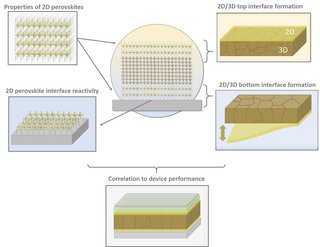
Two-dimensional perovskites: from fundamental understanding to their application at interfaces in perovskite solar cells
Joint project between University of Cologne (Dr. Selina Olthof) und University Wuppertal (Prof. Thomas Riedl) as part of the SPP2196
Funding agency: DFG
Halide perovskites have revolutionized the field of thin film solar cells with a remarkable increase in performance yielding efficiencies that are on par with single crystalline silicon. Aside from the perovskite material itself, interfaces to charge transport layers critically influence not only the overall performance but also the device stability. Recently, two dimensional (2D) perovskites have gained more and more attention as a strategy to tailor the interfaces in devices. They have turned out to be a key to unlock high efficiencies and improved stability in perovskite solar cells, in particular when employed at the interface between the photoactive 3D perovskite and the charge transport layers. The reasons for these improvements are a subject of a vigorous ongoing debate and a clear understanding of the nature of these 2D/3D interfaces is still in its infancy.
In this project, we will start off with a systematic investigation of pure 2D perovskites and study changes in their electronic structure, optical properties, and their stability depending of the choice and size of the bulky A-site cation. In comparison to their 3D analogues, their ability to form stable interfaces with charge transport materialswill be studied in detail. This is particularly important, as no research on the chemical interaction between 2D perovskites and metal-oxides has been published so far. Next, 2D perovskites will be integrated as thin layers on top and/or below an optimized 3D perovskite absorber material. Detailed analysis of these heterostructures will allow us to unravel how these bulky cations and the specific processing parameters affect the formation, electronic structure, and dimensionality of the respective interlayer. The insights gained from these fundamental studies will be correlated to the electrical characteristics of unipolar (hole-only; electron only) devices based on 2D/3D perovskite interfaces. Ultimately, the most promising combinations of 2D and 3D perovskites will be integrated in solar cells. We are in particular interested in comparing the open circuit voltage with the quasi Fermi level splitting to understand the contribution of parasitic recombination and limited charge extraction to the overall losses in device performance. This will help to clarify whether the presence of 2D interfacial layers can suppress recombination that would otherwise occur if the 3D material is in direct contact with other charge transport layers, such as fullerenes, metal-oxides, etc. Aside from shelf-life under various conditions (inert, ambient, heat), the operational stability of pure and mixed-halide systems is of paramount interest. In the latter systems, we will directly study the impact of 2D/3D interfaces to potentially mitigate the notorious halide segregation.
The fundamental understanding that will be gained in this project will be indispensable for further substantial improvements of efficiency and long-term stability of perovskite solar cells.
MUJUPO
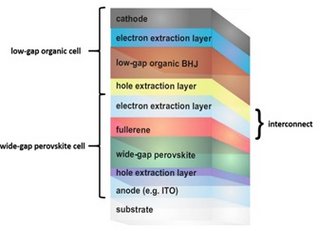
Hybrid multi-junction solar cells based on a monolithic integration of a wide-bandgap organo-metal-halide perovskite and low-gap organic polymer sub-cells
Joint project between University of Cologne (Dr. Selina Olthof) und University Wuppertal (Prof. Thomas Riedl)
Funding agency: DFG
Tandem solar cells based on a serial connection of wide-gap and low-gap sub-cells allow to minimize losses due to thermalization and thereby unlock elevated efficiencies. In organic multi-junctions the wide-gap cell (energy-gap about 1.8 eV), which should simultaneously provide a high Voc and high Jsc, currently states the main limitation. Even in the best organic wide-gap devices the voltage loss, i.e. 1/q*Eg - Voc, is unsatisfactorily high (about 0.8-1 V).
In this project we intend to design and realize hybrid multi-junction solar cells where the wide-gap sub-cell is based on an organo-metal halide perovskite absorber, which allows for a voltage loss as low as 0.3-0.4 V.
Reports of single junction perovskite cells with an efficiency >20% are accompanied by serious concerns about the stability of established perovskites like methyl ammonium lead iodide (MAPbI3). Perovskites based on mixed cations (e.g. MA and Cs) and mixed halides (e.g. I and Br), such as MA1-xCsxPb(I(1-y)Bry)3, bear the potential of enhanced stability. In general, the addition of Cs cations, which are smaller than MA, as well as the addition of Br, both lead to a widening of the bandgap of the perovskite, which is favorable for their use in a tandem cell. Regarding the sub-cell with low energy gap (1.2-1.3 eV), organic photo-active materials are available and some systems will be provided by the group of Prof. Janssen (TU Eindhoven) for this project. As of yet, no multi-junction devices of wide-gap perovskite cells based on MA1-xCsxPb(I(1-y)Bry)3 and low-gap organic cells have been reported.
In this project we will first identify an optimum wide-gap perovksite material along with a robust preparation protocol. Alongside, the careful analysis of its electronic structure by photoelectron spectroscopy (PES) will be of paramount importance. Until now these studies are lacking for perovskites like MA1-xCsxPb(I(1-y)Bry)3. The outcome of this research states the prerequisite for the selection of optimum interfacial materials that not only improve charge extraction but at the same time enable enhanced stability of the entire cell. As an example, microporous TiO2 is an established electron extraction material, that has to be prepared at high temperatures (>400°C) and its photocatalytic nature is frequently associated with reliability issues in perovskite cells. Opposed to that, we aim to use cross-linkable organic semiconductors or metal-oxides that can be prepared at temperatures below 100°C. In a combined approach of PES with dedicated device testing (e.g. unipolar electron/hole-only), we aim to identify optimum charge extraction layers for the selected wide-gap perovskite. These interfacial materials will also be the platform for the design of an interconnect, which must allow the loss-free monolithic integration of the sub-cells. We expect to achieve long-term stable hybrid tandem cells prepared at low temperatures (<100°C) with an efficiency > 20%.
TIDE

Template-Designed Organic Electronics
Funding Agency: DFG
TIDE is a DFG-funded Research Training Group (RTG) providing a structured and interdisciplinary doctoral training program in the field of Organic Electronics. The program brings together more than 13 principal investigators with complementary expertise, covering Physical Chemistry, Organic Chemistry, Theoretical Chemistry, Physics, and Materials Science. This breadth enables a comprehensive scientific approach to complex problems in organic and hybrid electronic materials.
Following a successful first funding phase, TIDE has been granted a second funding period by the DFG, reflecting the high scientific quality of the research program and the strength of the doctoral training concept. We are proud of this continued support, which allows us to further deepen the scientific scope of TIDE and to strengthen its long-term impact. Because of my recent move from away from the University of Cologne, in the upcoming funding period the Research Training Group will also be extended to the University of Wuppertal, thereby further broadening the institutional and methodological base of the program.
Within TIDE, my group contributes expertise on the formation and electronic properties of interfaces between ordered substrates and small molecules. We focus on the investigation of electronic structure and interfacial interactions using surface-sensitive techniques such as ultraviolet photoelectron spectroscopy (UPS) and X-ray photoelectron spectroscopy (XPS). Low-energy electron diffraction (LEED) is employed to assess molecular ordering and growth modes, enabling a detailed correlation between structural order and electronic properties at organic–inorganic interfaces.