
Oktober 2026
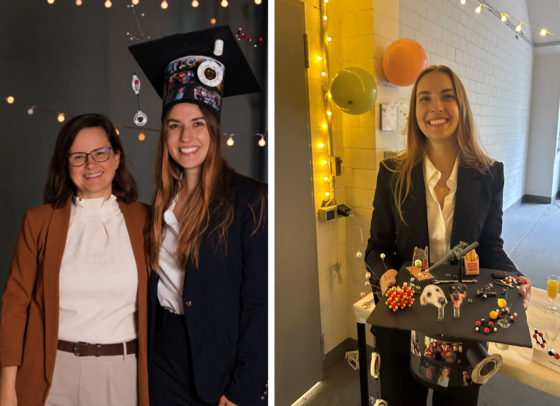
Our doctoral student Dilara Öz successfully defended her dissertation, titled “Substrate Effects and Surface Electronic Properties in Thermally Evaporated Halide Perovskites: A Photoelectron Spectroscopy and REELS Study,” on October 15. We warmly congratulate her on earning her doctorate and are glad you’ll be staying with us a while longer!
July 2026
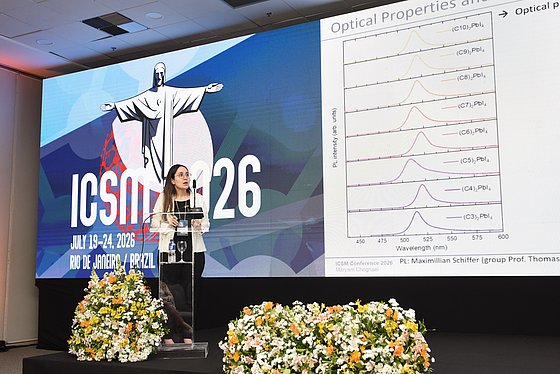
Our doctoral student Maryam Choghaei attended ICSM 2026 in Rio de Janeiro in July. There, she spoke to a large audience about her latest findings on the electronic structure of 2D perovskites and was able to enjoy a bit of Rio in addition to the scientific proceedings.
Juni 2026

We are pleased that our team has grown a bit more, and Syed Asim Ali is now actively supporting us as our new student assistant (HiWi). We extend a warm welcome to him!
Mai 2026

The Night of Technology took place in the Bergisch City Triangle for the first time and the turnout was overwhelming. From 6 p.m. to midnight, our university was constantly bustling with visitors. Visitors of all ages from preschoolers to grandparents, high school students, college students, and many tech enthusiasts took the opportunity to experience research and technology up close. Together with the research groups led by Daniel Neumaier, Thomas Riedl, and Patrick Görrn, we had an exhibition booth. The many conversations, questions, and sustained curiosity meant there was practically no time to catch our breath.
Mai 2026

We were very pleased to welcome Nitin Padture to our research group. As part of the CM@S Colloquium, he gave a presentation titled “The Promise of Halide-Perovskite Solar Photovoltaics.” His talk focused on the current challenges and opportunities associated with halide-perovskite solar cells, with a particular emphasis on mechanical issues at interfaces and in flexible devices.
Oktober 2025

Es It was a great pleasure for me to introduce myself to the faculty at the Bergische University of Wuppertal’s reception for newly appointed faculty members and to have my first personal conversations with my new colleagues.
(Photo: Bergische University of Wuppertal / Friederike von Heyden)
September 2025

The PerFunPro conference in Konstanz is now behind us. It marked the conclusion of our Special Research Program (SPP) 2196 on halide perovskites. We’ve had six exciting years, during which I had the privilege of helping shape the activities within the SPP together with Lukas Schmidt-Mende and Vladimir Dyakonov. I would like to extend my special thanks to all participants, not only those at the conference, but also the PIs and doctoral students who supported the Collaborative Research Program with such dedication. It was a pleasure for me, and the conference served as a fitting and successful conclusion to this time we spent together.
August 2025

On August 19, Baris Öcal successfully defended his doctoral dissertation on the topic “Optoelectronic Properties of Highly Dipolar Merocyanines on Highly Ordered Surfaces.” We extend our heartfelt congratulations to him and wish him all the best in his future scientific and professional endeavors.
Juli 2025

Inaugural Lecture at the University of Wuppertal
This week, I delivered my inaugural lecture at the University of Wuppertal. As the new professor of Materials and Surface Analysis in the School of Electrical Engineering, Information Technology, and Media Technology, this was an important personal milestone. The lecture focused on how material properties, particularly electronic structure, can be understood using modern surface analysis techniques. I would like to thank all my colleagues, students, and guests for their interest, as well as my team for their support.
Juli 2025

Second Funding Period Approved for the DFG Graduate School TIDE
The German Research Foundation (DFG) has approved the second funding period for the TIDE Graduate School. This means the structured doctoral program will continue for another 4.5 years. The Graduate School brings together collaborative doctoral projects at the University of Cologne and the University of Bonn. In the future, the University of Wuppertal will also be integrated as an associated site.
Mai 2025
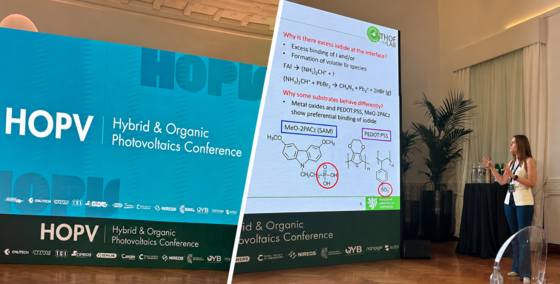
Dilara Öz gave a presentation at the HOPV 2026 in Rome. She presented our latest findings on how different substrates influence the thermal evaporation and composition of perovskite layers. In addition to engaging discussions, there was also time to network with the international perovskite community.
Mai 2025

Odd–Even Effect in 2D Perovskites Elucidated
In a recently published study, we collaborated with Maryam Choghaei and international partners to investigate a pronounced odd–even effect in lead iodide-based 2D Ruddlesden–Popper perovskites. Using a combination of spectroscopy, DFT calculations, and mobility measurements, we demonstrate that the parity of the spacer cations (odd vs. even number of carbon atoms) has a direct influence on the crystal packing, the Pb–I–Pb bond angles, and the optical and electronic properties.
The results provide important insights into structure-property relationships in 2D perovskites and are relevant for both bulk materials and interfaces.
April 2025

New Study on Interfacial Effects in Halide-Based Perovskites
In a recent study, my Ph.D. student Seren Dilara Öz demonstrates that interfaces play a crucial role in the thermal evaporation of mixed halide perovskites. Our results show that, on certain substrates, iodide preferentially remains at the interface and can completely displace bromide there, which significantly influences the composition of the thin film. At the same time, we were able to show that a thin PbI₂ interlayer can stabilize these effects. This work underscores the central importance of interface selection for the controlled fabrication of mixed halide perovskite films.
April 2025

If you'd like to learn more about me, my research, and what motivates me in a nutshell: My “Meet the Professor” video is now available on YouTube.
▶︎ Zum Video
Februar 2025

As of today, I am a professor of materials and surface analysis at the University of Wuppertal as part of a Heisenberg Professorship funded by the German Research Foundation (DFG). I am very much looking forward to collaborating with my colleagues, setting up new laboratories, and developing the department in Wuppertal.
(Photo: University of Wuppertal / Friederike von Heyden)


